Most AI-bias coverage in this category stops at "the training data is imbalanced." A study published in Nature Medicine this August adds a sharper, more uncomfortable finding: even after you fix the model's skin-tone balance, the way you explain its answer to a user can still work against the exact people the fix was meant to help.
This is a breakdown of what the study actually found, why the effect was so different for lay people versus physicians, and what it means for a product like Rupam — which is built for the lay-user side of that split, not the clinical one.
The study, briefly
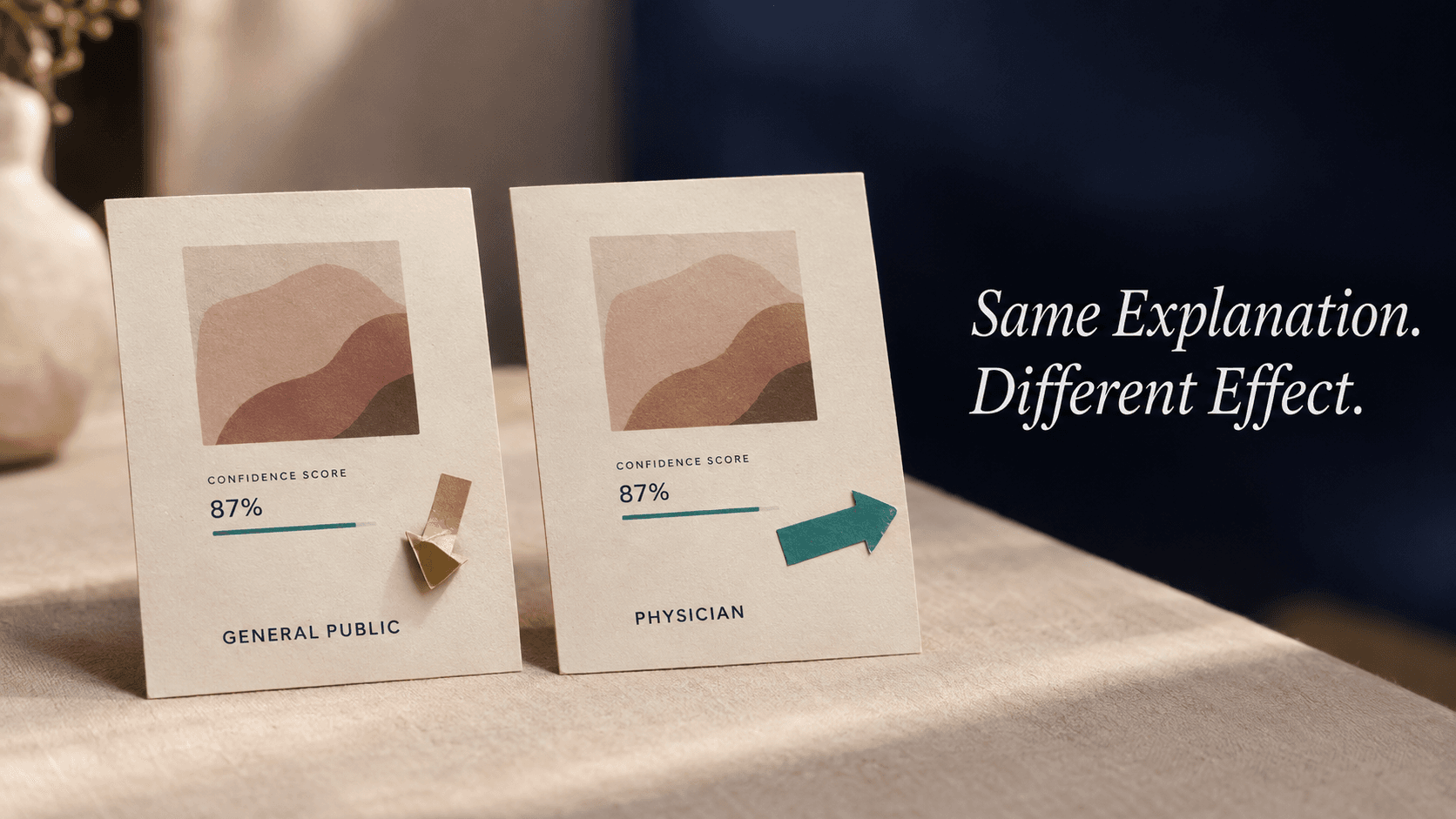
Researchers from Columbia, MIT, Stanford, Johns Hopkins, and Northwestern ran two experiments. In the first, 623 members of the general public classified 12 skin images each as melanoma or a benign mole (nevus). In the second, 153 primary care physicians (plus 320 medical students, for comparison) worked through open-ended differential diagnoses on a similar image set. Both groups got help from an AI model — and from one of four explanation styles layered on top of it: a plain confidence score, a GradCAM heatmap, similar-case retrieval, or a multimodal LLM writing out its reasoning in text.
Two separate interventions, easy to conflate
The part of this study most relevant to a skin-AI buyer is that it tested two genuinely different things, and kept them separate — which is rarer than it should be in this category's own marketing:
- A fairness-constrained model — trained (using a technique called CDANN) specifically to perform evenly across skin tones, rather than just well on average.
- Four explanation methods layered on top of that model's output — a confidence score, a visual heatmap, similar-case examples, or an LLM's written reasoning.
The distinction matters because the results for each were not the same.
What actually closed the skin-tone gap
The fairness-constrained model did the heavy lifting. For the general public, the accuracy gap between lighter and darker skin tones dropped from 3.2% to 1.7% — a 46.9% relative reduction. For physicians, it dropped from 4.5% to 2.7%, a 35.6% relative reduction. Both reductions were attributed primarily to the balanced model itself, not to any specific explanation method sitting on top of it.
Where it got more complicated: automation bias
The explanations weren't neutral, either — and they affected lay people and physicians in opposite ways. For the general public, a correct LLM explanation improved their final accuracy by +13.4%. That sounds like a clean win, until you see the other half: an incorrect LLM explanation dragged their accuracy down by −21.1% — a bigger effect in the wrong direction than the gain in the right one.
Physicians showed almost none of this pattern. Across all four explanation methods, an incorrect AI prediction had minimal effect on their final decision — they were, in the researchers' framing, resilient to bad AI guidance in a way lay users were not.
A second, adjacent finding worth knowing
A separate September 2026 preprint looked at a related but different question: when a skin-AI model performs worse in a new setting, how much of that is skin-tone underrepresentation versus a mismatch in which conditions are common in that setting (a "disease-distribution shift")? In the settings that paper evaluated, distribution shift accounted for more of the drop than skin tone alone — cancer-trained models fell from 0.62 to 0.21 balanced accuracy when the case mix genuinely changed, while same-disease skin-tone gaps stayed smaller (0.10–0.18) and less consistent. It's a reminder that "the model doesn't work as well here" can have more than one root cause, and skin tone, while real and well-documented (see our earlier piece on the research), isn't always the only one operating at once.
What this means for a consumer-facing product, not a clinical one
Rupam sits on the lay-user side of this study's split, not the physician side — a customer scanning their own face on a phone is much closer to the general-public cohort than to a primary care physician working a differential diagnosis. Two things follow directly from that:
- A balanced-performance model matters more than a well-worded explanation. If a vendor's pitch leans on how nicely their AI explains itself, that's not the part of this research that actually closes the skin-tone gap — the training approach is.
- Confident-sounding AI output deserves a specific kind of caution for a lay audience. This is part of why Rupam's results are framed as an insight or a read, never a confident diagnostic verdict, and always paired with guidance to see a dermatologist for anything that needs one — not as a legal formality, but because the research above shows that framing has a real effect on how much a non-expert trusts a wrong answer.
None of this is a diagnostic claim about Rupam's own product, and it shouldn't be read as one — Rupam is a cosmetic skin-analysis and personalization tool, not a melanoma-detection device, and the study above was conducted on clinical diagnostic tasks. It's cited here because the underlying finding — that fairness has to be built into the model, and that explanations carry their own risk for non-expert users — applies directly to how any skin-AI product aimed at consumers should be designed and described.
Frequently asked
- Does explainable AI reduce bias in dermatology AI?
- Partially, and not by itself. A 2026 Nature Medicine study found that a fairness-constrained model (trained to perform evenly across skin tones) reduced diagnostic accuracy disparities by 46.9% for lay people and 35.6% for physicians. The explanation methods layered on top of that model didn't drive the reduction — the balanced training did.
- Can AI explanations make diagnostic errors worse?
- For non-expert users, yes, in the specific study this article covers. A correct LLM-generated explanation improved lay users' accuracy by 13.4%, but an incorrect one reduced it by 21.1% — a larger effect in the wrong direction. Physicians in the same study were largely resilient to incorrect AI guidance across all explanation types tested.
- Is skin-tone bias the only reason AI dermatology models underperform in new settings?
- No. A September 2026 analysis found that in the settings it evaluated, a mismatch in which diseases are common (distribution shift) accounted for more of the performance drop than skin-tone representation alone, though both remain real, separately documented issues.
Sources
See how we handle this at Rupam
Non-diagnostic framing, per-tone benchmark reporting, and where our own evaluation is still thin — published rather than summarized.
View the accuracy report