Almost every D2C skincare brand ships some version of the same thing: a five-question quiz that asks the shopper to describe their own skin, then routes them to three products. It works well enough that nobody interrogates it — and it fails in a specific, measurable way that standard analytics won't surface.
The distinction that matters isn't quiz versus AI. It's self-report versus measurement — and then, one level deeper, what that measurement was validated against. Get the second part wrong and an AI scan is just a slower quiz with better branding.
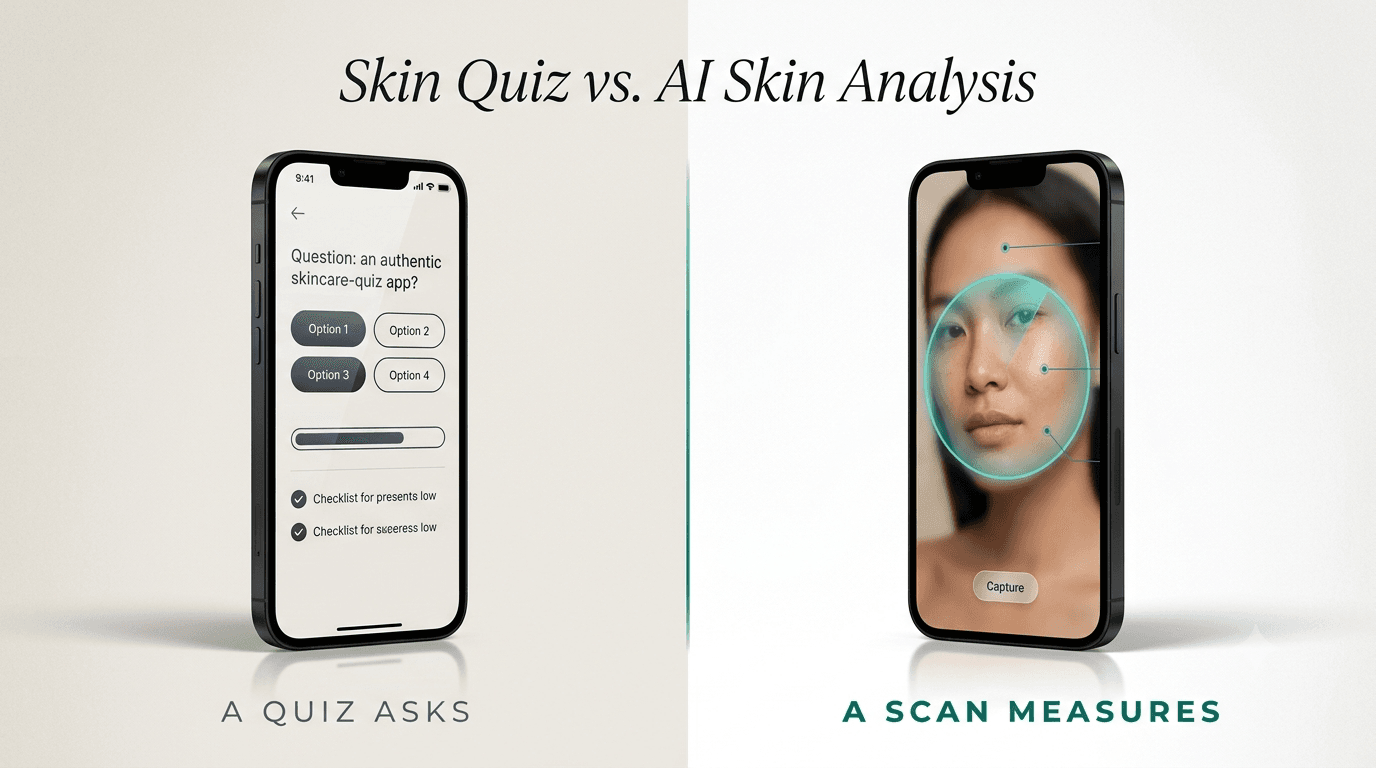
The core difference: a quiz asks, a scan measures
A skin quiz is a questionnaire feeding a rules engine. The shopper self-reports skin type, concerns and goals; a decision tree maps those answers to a product set. The output quality is capped by the accuracy of the shopper's self-description.
A skin scan replaces the questionnaire with an image. A computer-vision model reads the photo and returns graded parameters — pigmentation, texture, acne, hydration, pores, oiliness and so on — which then map to the same catalogue. Same destination, fundamentally different input: one is an opinion, the other is an observation.
Why quizzes underperform
Three failure modes show up consistently, and none of them are fixed by writing better quiz questions:
- Self-diagnosis is unreliable. Post-inflammatory marks left by old acne get reported as pigmentation. Dehydrated skin gets reported as dry when it is often oily and dehydrated at once. Sensitivity is almost entirely self-identified, with no consistent definition between any two shoppers.
- Recall bias skews the answer. People describe the skin they had during their most memorable recent flare-up, not the skin they have today. A quiz taken during a breakout week produces a routine built for a state that may not persist.
- Length trades accuracy against completion. More questions produce a better read and a worse completion rate. Most brands resolve that tension by shortening the quiz — which optimises the funnel and degrades the recommendation.
The result is a recommendation engine that is precise about the wrong inputs. It runs cleanly, produces a confident routine, and quietly mismatches a meaningful share of customers.
What the data actually shows
The public evidence for scan-based personalisation is genuinely encouraging, and it is worth being precise about whose numbers these are — none of the figures below are ours.
- Haut.ai's deployment with Grupo Boticário across a roughly 4,000-store retail network reported a substantial skincare AOV lift in its pilot phase — the most cited retail-scale proof point in the category, and a vendor-reported pilot figure rather than an independently audited one.
- Skinwise / Inference Beauty reported roughly a 17% increase in basket size, and conversion improvements ranging up to 50% on scan-led journeys compared with their prior setup.
- Haut.ai's own survey work has reported that roughly one in three women now use AI in some form for skincare advice — relevant less as a conversion stat than as evidence the behaviour is no longer novel.
Read those as directional rather than as a forecast for your store. They come from different catalogues, different markets and different baseline experiences. What they establish is that the mechanism works — not that any specific percentage transfers to you.
Why AI-based alone isn't the differentiator
By 2026, AI-powered describes nearly every tool in this category, including several that are a quiz with a camera bolted on. The differentiator was never the label. It is measurement quality: whether the model actually reads the parameter it claims to read, on the skin your customers actually have.
The catch nobody mentions: measurement is only as good as what it was evaluated against
This is where most quiz-to-AI migrations lose the gain they were promised. A scan is only an upgrade over self-report if the model was evaluated on skin like your customer's. Most weren't: public dermatology datasets skew heavily toward lighter skin, and the majority of images in them carry no skin-tone label at all — so per-tone accuracy frequently isn't reported because it was never measurable.
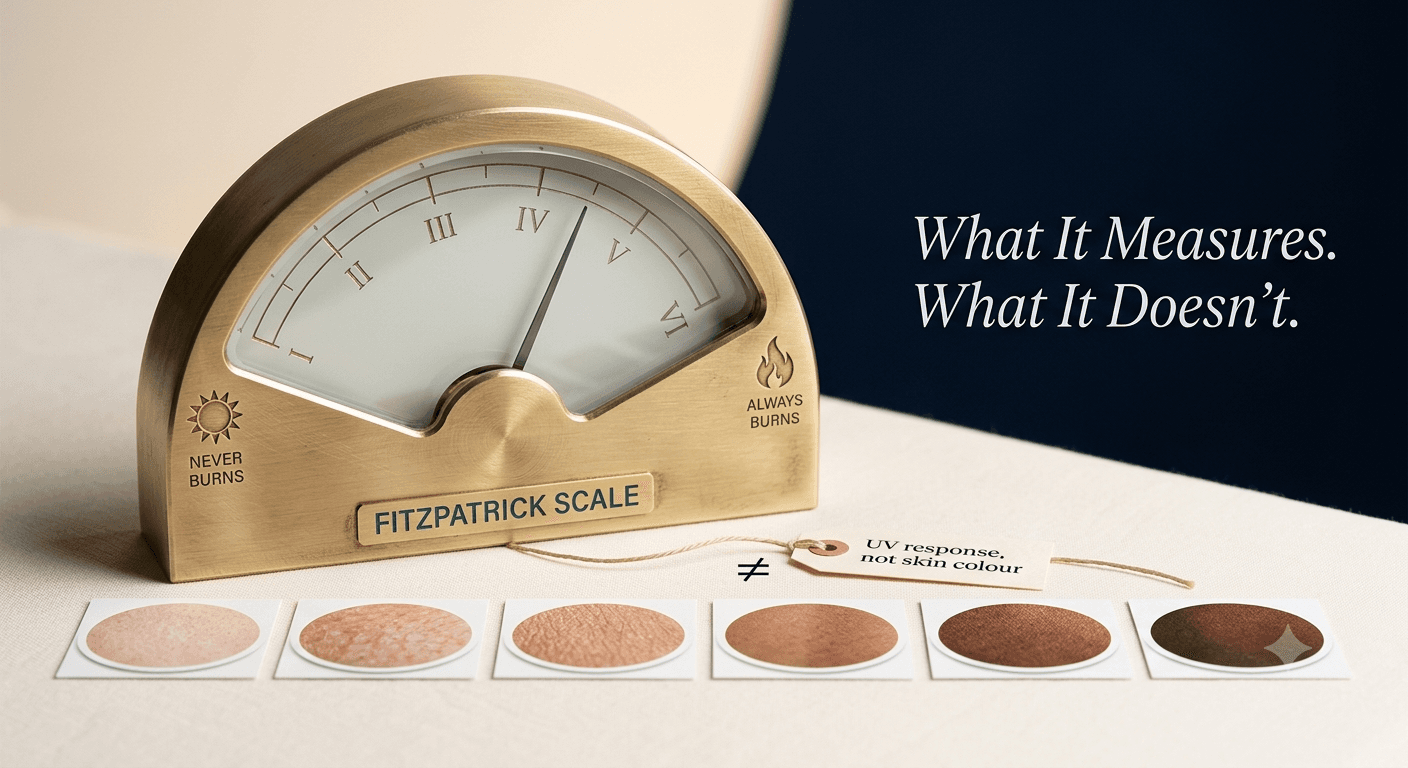
For a Bharatiya brand this is decisive rather than academic. If a model under-reads pigmentation on Fitzpatrick V skin, the scan hands your catalogue a weak signal, the routine misses, and the customer returns the order — the exact failure the quiz was replaced to fix. We covered the underlying research in why Fitzpatrick III–VI is still an edge case in most skin AI.
A scan measured on the wrong population is a more expensive way to guess.
What to actually ask a vendor before switching
This list is deliberately vendor-agnostic. Run it against us as readily as against anyone else — a vendor that can't answer these is asking you to take the upgrade on faith.
- Can you show accuracy broken out by Fitzpatrick type? A single headline accuracy number tells you nothing about the tones that make up your customer base. If a per-tone breakdown doesn't exist, the model wasn't evaluated on the question that matters to you.
- Who graded the training and test data, and how many people graded each image? Single-labeller ground truth inherits one person's bias into every downstream number.
- How does the engine map a skin read to my specific catalogue? Ask whether you start on a default ingredient-to-concern mapping or train against your own assortment — and how long the second option takes.
- What is the realistic integration timeline, split by phase? A widget or plugin going live is a same-day job for most teams. Tuning catalogue mapping against your SKUs is not. Be suspicious of a single live-in-minutes number that quietly bundles both.
- What does the API actually return, and what does it refuse to claim? Ask for the response shape, and ask where the product stops — a vendor that names its limits is giving you more information than one that doesn't.
- What happens to customer face images? Retention, deletion path, and who can access them. Ask for specifics rather than a compliance badge.
How Rupam fits this
Rupam is a skin-analysis API built for Fitzpatrick III–VI Bharatiya skin by default rather than retrofitted to it. A single photo returns a 14-parameter read — acne, pores, dark circles, pigmentation, wrinkles, oiliness, redness, texture, fine lines, eye bags, blackheads, hydration, moles and skin glow — which then maps to your catalogue. Integration runs through a REST API, a JS widget or the Shopify plugin, and plans with scan volumes are listed openly on the pricing page.
On the numbers above: we are not claiming Grupo Boticário's or Skinwise's results as our own, and we would treat any vendor quoting someone else's case study as their own projected outcome with caution. What we will say is the mechanism — measurement beats self-report, provided the measurement was validated on your customers' skin.
Frequently asked
- Is AI skin analysis better than a skin quiz?
- For recommendation accuracy, generally yes — a quiz is limited by how well a shopper can describe their own skin, and self-diagnosis of concerns like pigmentation, dehydration and sensitivity is unreliable. But the advantage only holds if the model was trained and evaluated on skin tones matching your customer base. A scan validated mainly on lighter skin can perform no better than a quiz for a Fitzpatrick III–VI audience.
- Do skin quizzes actually increase conversion?
- They usually beat no personalisation at all, which is why they became standard. The reported gains from scan-based personalisation are larger: Skinwise / Inference Beauty reported roughly a 17% basket-size increase and conversion improvements up to 50%, and Haut.ai reported a substantial AOV lift in its Grupo Boticário retail pilot. These are vendor-reported figures from other brands' catalogues and markets — directional evidence that the mechanism works, not a forecast for a specific store.
- How long does it take to replace a skin quiz with AI skin analysis?
- Split the question in two. Getting a widget or Shopify plugin live on the storefront is a same-day task for most teams. Mapping the skin read to your own catalogue is the longer piece — you can launch on a default concern-to-ingredient mapping and tune against your actual assortment afterwards. Any vendor quoting one flat number for both is compressing the part that determines whether the recommendations are any good.
Sources
- Grupo Boticário retail deployment — reported skincare AOV lift across ~4,000 stores — Haut.ai (vendor-reported pilot), 2024
- Reported ~17% basket-size increase and up to 50% conversion improvement on scan-led journeys — Skinwise / Inference Beauty (vendor-reported), 2025
- Survey finding that roughly one in three women use AI for skincare advice — Haut.ai survey, 2025
Compare your current quiz setup against a measured read
What changes when the input is an observation instead of a self-report — mechanism, integration paths, and the limits we state up front.
See it for D2C beauty