Almost every skin-AI product claims a Fitzpatrick type as part of its output, and almost every buyer accepts that number as a skin-tone reading. Neither the scale's inventor nor the dermatology literature ever described it that way — the Fitzpatrick scale was built to answer a narrow clinical question about sunburn risk, not to classify how skin looks.
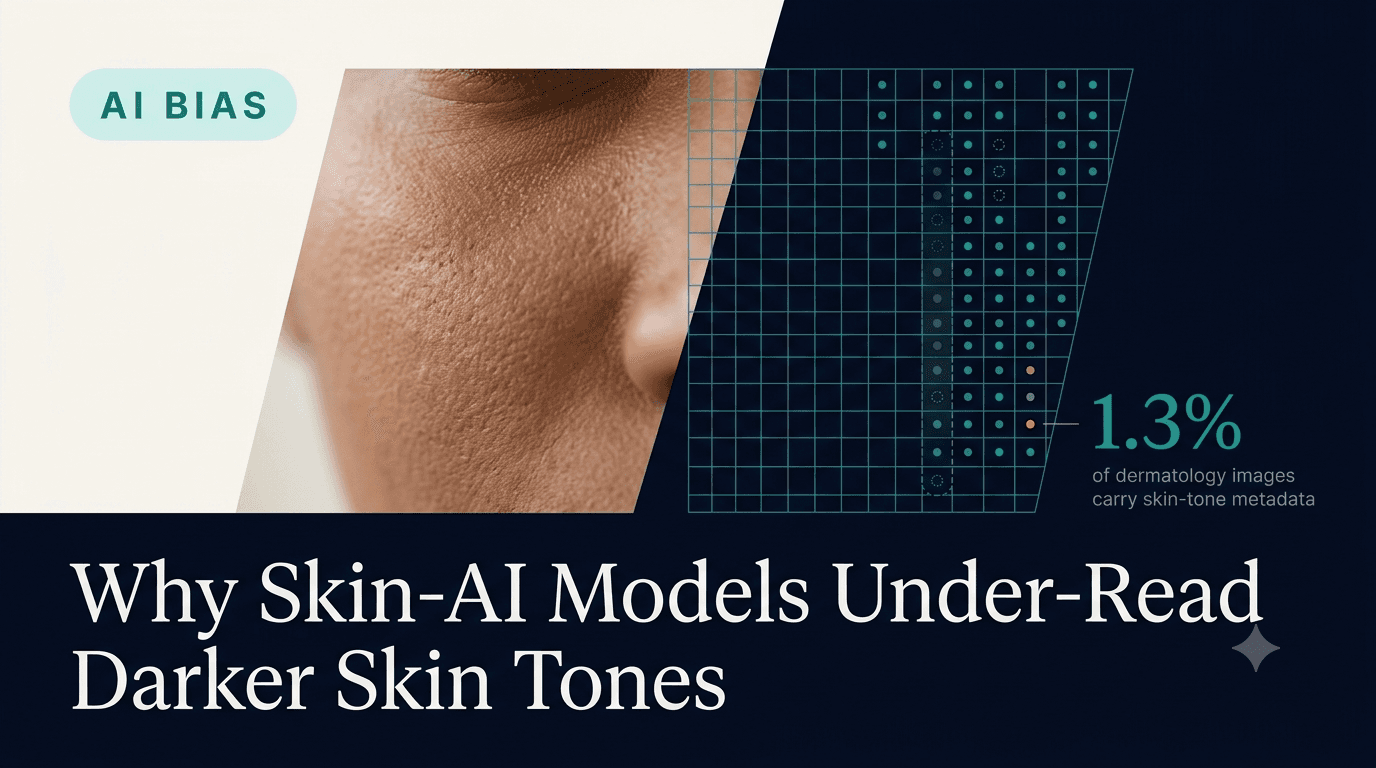
That gap between what the scale was designed for and how the AI industry uses it isn't a footnote. It's the root of a specific, documented accuracy problem covered in our piece on why skin-AI models under-read darker skin tones. This one stays with the scale itself: what it actually measures, where its six categories come from, what's replacing it, and the one question it should make you ask any AI vendor.
What the Fitzpatrick scale actually is
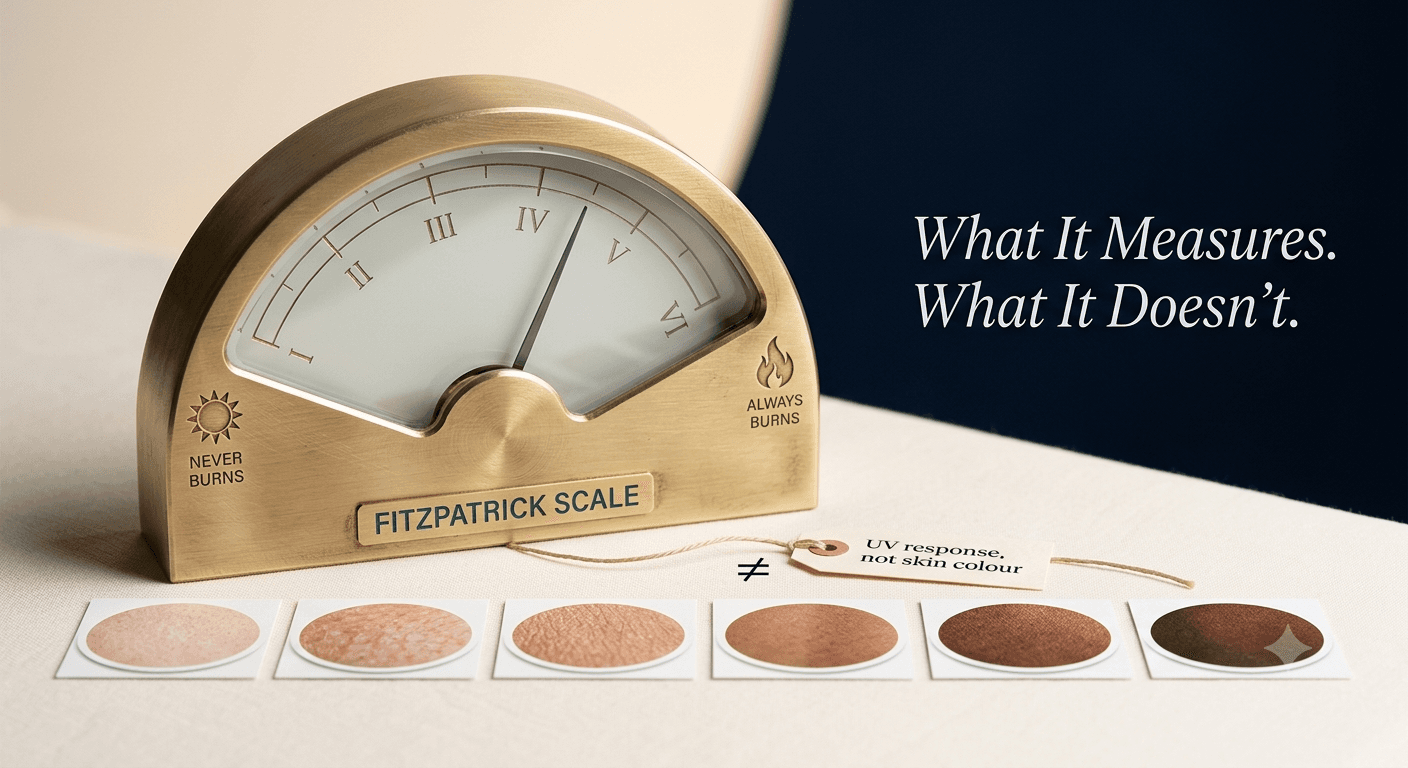
Dermatologist Thomas B. Fitzpatrick introduced the scale in 1975 to solve a practical phototherapy problem: how much ultraviolet light could a given patient tolerate before their skin burned, so UV dosing for psoriasis and other conditions could be set safely. The scale classifies sun-reactive behaviour — how readily skin burns and how readily it tans — not the visual colour of skin.
The six categories, explained plainly
| Type | Sun-reactive behaviour (what Fitzpatrick actually classifies) |
|---|---|
| I | Always burns, never tans |
| II | Usually burns, tans minimally |
| III | Sometimes burns mildly, tans gradually |
| IV | Rarely burns, tans well |
| V | Very rarely burns, tans easily and deeply |
| VI | Never burns, deeply pigmented |
Notice what's absent from that table: no colour values, no reflectance measurements, nothing quantitative. Each category is a self-reported or clinician-estimated behavioural answer to "what happens to your skin in the sun," which is exactly why it works well for phototherapy dosing and works poorly the moment someone tries to use it as a precise, objective skin-tone measurement.
Why it became a skin-tone proxy anyway
The Fitzpatrick scale became dermatology's default skin-tone label mostly by default rather than by design — it was the only widely taught, widely understood six-point system available when the field needed some way to describe skin diversity in datasets and clinical notes. Once major public dermatology datasets started using it as a metadata field, every model trained on those datasets inherited it as the ground truth for "skin tone," whether or not that mapping was ever accurate.
That inherited habit is now industry-wide. When a skin-AI vendor says its model "classifies Fitzpatrick type," it is almost always describing a colour/tone estimate produced by a model trained on Fitzpatrick-labelled images — not a measurement of UV sensitivity, which is what the scale was actually built to capture.
Its documented limitations
Two separate bodies of research point at the same underlying problem from different angles.
- It was never validated as a colour taxonomy. Research published in npj Digital Medicine examining the Fitzpatrick scale's use as an AI labelling standard notes that self-reported Fitzpatrick type correlates poorly with measured skin reflectance — the label two people give themselves for the same objective skin tone can differ.
- Its granularity skews toward lighter tones. Types I–III span a narrower range of actual pigmentation than types IV–VI combined, which in practice means the scale offers finer distinctions among lighter skin and coarser, less reliable distinctions among darker skin — precisely the population a India-facing product needs to read accurately.
- Even automated classifiers struggle at the darker end. A 2026 classifier study in the Journal of the American Academy of Dermatology found models trained to predict Fitzpatrick type from images showed meaningfully lower agreement with dermatologist ratings at types V–VI than at the lighter end of the scale — the label is least reliable exactly where a Bharatiya product needs it to be most reliable.
What's replacing or supplementing it
Two more objective alternatives have gained traction precisely because they measure something quantifiable instead of a self-reported behaviour:
- Individual Typology Angle (ITA). A colorimetric measure calculated from a skin sample's lightness and yellow-blue values, producing a continuous number rather than a six-point bucket. It's derived from actual reflectance measurements, which is why some skin-AI systems use it internally even when they still report a Fitzpatrick-style label for familiarity.
- Monk Skin Tone (MST) Scale. A 10-point scale developed by Harvard sociologist Dr. Ellis Monk and released publicly by Google in 2022, built specifically to give finer, more evenly-spaced coverage across deeper skin tones than Fitzpatrick's six categories provide.
Neither has displaced Fitzpatrick as the field's default — it remains the term buyers search for and the label most datasets still use — but both point at the same conclusion from a different direction: an instrument built to answer "how much UV can this skin take" is not the instrument you'd design today if the goal was accurate, evenly-distributed skin-tone measurement from the start.
What this means when evaluating an AI vendor's claims
"Classifies Fitzpatrick type" is not, by itself, a claim about accuracy — it's a claim about which label a model outputs. The useful follow-up question is what that classification was validated against: reflectance measurements, expert dermatologist consensus, or the same self-reported labels the scale was never built to standardise. A vendor that can name its validation method is describing a measurement. One that can't is describing a guess with a scientific-sounding label attached.
Rupam classifies Fitzpatrick type as one of the parameters in its skin-analysis output, trained and evaluated on Bharatiya skin across the III–VI range specifically because that's where the scale's own documented weak point sits. Current per-parameter results, including this one, are published on the accuracy page rather than summarised as a single headline number.
Frequently asked
- What is the Fitzpatrick scale?
- A six-category system dermatologist Thomas B. Fitzpatrick introduced in 1975 to classify how skin responds to ultraviolet light — how readily it burns and how readily it tans — originally to help dose phototherapy safely. It is not a colour or skin-tone measurement system, though it is widely used as a proxy for one.
- Does the Fitzpatrick scale measure skin color?
- Not directly. It classifies sun-reactive behaviour (burning and tanning response), not colour. It became a skin-tone proxy because it was the most widely available six-point system when the dermatology field needed one for datasets and clinical notes — not because it was designed or validated to measure colour. More objective alternatives like the Individual Typology Angle (a colorimetric measure) and the Monk Skin Tone scale exist for that purpose.
- What are the six Fitzpatrick skin types?
- Type I always burns and never tans; Type II usually burns and tans minimally; Type III sometimes burns mildly and tans gradually; Type IV rarely burns and tans well; Type V very rarely burns and tans easily and deeply; Type VI never burns and is deeply pigmented. Each category describes UV response, not a specific colour value.
Sources
- Fitzpatrick, T.B. — The validity and practicality of sun-reactive skin types I through VI — Archives of Dermatology, 1988
- The Fitzpatrick scale as an AI labelling standard — self-report vs. measured reflectance — npj Digital Medicine, 2023
- Fitzpatrick-type classifier agreement across skin types — Journal of the American Academy of Dermatology, 2026
- Monk Skin Tone Scale — a 10-point scale for more inclusive skin-tone representation — Google Responsible AI, 2022
See what we test against, and how
Our current Fitzpatrick classification results and every other measured parameter, published on their own terms rather than folded into one headline number.
View the accuracy report