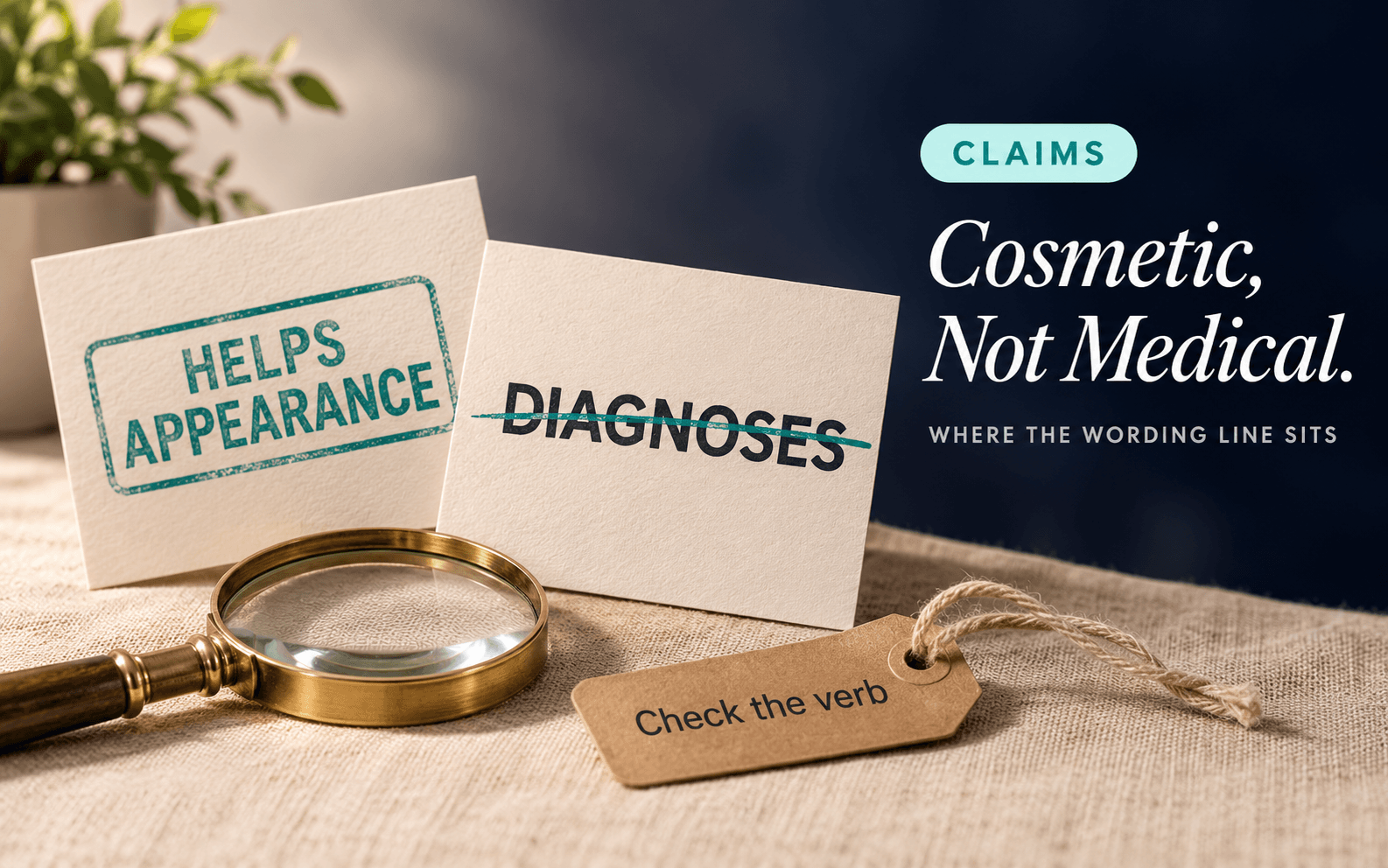
A skin scan can be described in two sentences that sound almost the same. "See the visible signs of uneven tone." Or: "Diagnoses and treats pigmentation." The first sits in the world of cosmetics. The second uses words that regulators read as medical. The technology did not change between those sentences. Only the copy did.
This post is about that line. It sets out what the rule texts actually say in the EU, India and Germany, gives six tests that cosmetic claims have to meet in Europe, and ends with a five-minute check for any sentence you are about to publish. It is a plain-language summary with sources named below. It is not legal advice.
The verb that changes the rulebook
India's Drugs and Cosmetics Act defines a cosmetic in Section 3(aaa) by what it is for: cleansing, beautifying, promoting attractiveness or altering appearance. A drug is defined by a different purpose — treating, curing or preventing disease. Cosmetics Rules 2020 carry that split into Rule 36, which bars a cosmetic from bearing a false or misleading claim.
The EU uses a similar structure in the Medical Device Regulation (MDR). Under Article 2(1), software with a medical purpose is a medical device in its own right. Annex VIII Rule 11 then sorts that software by how risky a wrong decision would be: decision-support software generally lands in Class IIa or higher. The Commission's MDCG 2019-11 guidance explains how to read those rules. A tool that only describes appearance is trying to stay on the other side of that line.
Six tests the EU applies to cosmetic claims
Commission Regulation (EU) No 655/2013 sets six common criteria for claims about cosmetic products. Article 1 says the criteria apply to a claim in any form and any medium — a website counts, not just a label. The Annex lists the six tests:
| Test | What the rule asks | What it means for a skin scan |
|---|---|---|
| Legal compliance | No claim that a public authority has approved the product when that is not true, and no benefit claimed from mere compliance with minimum legal rules. | "Approved by regulators" needs a real approval to point at. Compliance is not a selling point. |
| Truthfulness | Do not attribute properties the product does not have; an opinion is not a verified claim unless evidence backs it. | A score shown on screen is not the same as a measurement of a skin condition. |
| Evidential support | Claims need adequate, verifiable evidence. Studies must be relevant, well designed and repeatable. | A percentage about a different dataset or a different device is not support for your claim. |
| Honesty | Presentation must not go beyond the evidence, and a characteristic is not unique if rivals have it too. | An "only us" claim needs more than an absence of competitors in the demo. |
| Fairness | Claims must be objective and must not denigrate competitors or legally used ingredients. | Bias claims about other tools should be sourced, not sneered. |
| Informed decision-making | Claims must be clear, understandable and enough for the average user to choose. | If a qualifier is needed to make the headline true, the headline is the problem. |
The rule's own preamble adds an honest caveat: the criteria apply once a product has been assessed as a cosmetic, and national authorities and courts decide that case by case. That is why the table is a writing guide here, not a legal classification.
India: the ad code sits on top of the law
The Advertising Standards Council of India (ASCI) Code asks for truthful and honest advertisements. Where an ad says its claim rests on independent research, the source and date must be given. Substantiation has to be produced when a complaint is examined.
ASCI's disclaimer guidance is blunt about the trick that catches skincare copy: a disclaimer may explain a claim, but it cannot contradict the headline or rescue a false one, and it cannot hide material information. If the main sentence says "cures pigmentation" and small print says "cosmetic use only", the small print does not fix the sentence. Change the sentence.
ASCI also has specific guidance for skin-lightening and fairness advertising. Ads must not suggest that darker skin is inferior, unhappy or at a disadvantage, and must not tie skin colour to caste, community or social status. That matters for any skin-AI product whose honest selling point is that it was built for Fitzpatrick III–VI skin: the contrast should be about missing data, never about which skin is better.
Germany: a vague claim can mislead as well
Sections 5 and 5a of Germany's Act Against Unfair Competition (UWG) prohibit misleading statements and misleading omissions. The Act's own list of misleading practices includes falsely claiming that goods or services can cure illnesses, dysfunction or malformations. Its protection is not limited to consumers; competitors and other market participants are covered too.
A 2026 ICLG chapter on German consumer protection makes a second point worth keeping: vague claims can mislead when they have no specific, verifiable content, or when qualifying information is withheld. "Advanced AI skin health assessment" may be the kind of phrase a regulator asks you to define.
A five-minute check before you publish
| Risky phrase | Why it fails | Safer wording |
|---|---|---|
| "AI diagnoses acne" | Diagnosis is a medical-purpose word and can pull the tool into device territory. | "Flags visible signs of blemishes." |
| "Reduces pigmentation in two weeks" | A treatment outcome plus a time frame with no evidence behind it. | Describe what is observed, or remove the outcome and the time frame. Do not promise a change you cannot show. |
| "Clinically proven" | Needs evidence relevant to this product; ASCI also asks for source and date when research is cited. | Name the actual benchmark and method, only where those results are published. |
| "Dermatologist approved" | Implies an authority-style endorsement and needs real, current, documented backing. | "Reviewed by…" only with written consent and a description of what was reviewed. |
| "Works for all skin types" | Broader than any evaluation can support. | Name the tones and conditions actually evaluated, and link to the method. |
If the safer version still needs evidence you do not have, remove the claim. Putting the qualifier in a smaller font is not the same as making the claim true. The same habit applies to AI-generated imagery: if a visual implies a result that was never measured, the image is making the claim for you.
Where Rupam sits
Rupam is a cosmetic skin-analysis and personalisation tool. It is not a medical device, it does not give diagnoses, and its output is an insight to help choose products, not a clinical verdict. We publish per-parameter benchmark facts on our accuracy page rather than compressing them into one headline accuracy number, because a single figure hides which skin tones and which checks it came from.
The other boundary is privacy: a scan starts with a photo of a face. Our earlier post on face data and 2026's rules covers that side of the question. Here we are only talking about the words used to describe what the scan does. If you have a line of copy you are unsure about, send it to us and we will say what we can and cannot substantiate.
Frequently asked
- Is an AI skin-analysis tool a medical device?
- Not automatically. Under the EU MDR, software becomes a medical device when it has a medical purpose such as diagnosing, treating or monitoring disease — Rule 11 then sets its class. A tool that only describes appearance and suggests cosmetic products is aiming for a different category, but whether a specific feature crosses the line is a question for counsel.
- Can a disclaimer make a risky claim acceptable?
- Not if it contradicts the claim or hides something material. ASCI's guidance says a disclaimer can explain a claim but cannot correct a misleading headline. The reliable fix is to rewrite the headline so it is true on its own.
- What does "clinically proven" require?
- Evidence from a relevant, well-designed study of the product and the benefit being claimed — not a number borrowed from another device or dataset. ASCI also asks that the source and date of independent research be given when it is cited. If you cannot name the study, do not use the phrase.
- Why does skin-colour wording matter for a claims post?
- ASCI's skin-lightening guidelines say ads must not suggest darker skin is inferior or at a disadvantage. For a product built for Fitzpatrick III–VI skin, the honest story is about under-represented training data and measured gaps, not about one tone being better than another.
- Who decides whether our claim is cosmetic or medical?
- National authorities and courts decide case by case in the EU, taking the average user's perception into account. In India, the statutory definitions and ASCI's self-regulation both matter. A qualified lawyer in each market you sell into is the right person to apply them to your copy.
Sources
- Commission Regulation (EU) No 655/2013 — common criteria for cosmetic claims, with the Annex — EUR-Lex, 2013 · link
- Regulation (EC) No 1223/2009 on cosmetic products, Article 20 (claims) — EUR-Lex, 2009 · link
- Regulation (EU) 2017/745 (MDR), Article 2(1) and Annex VIII Rule 11 — EUR-Lex, 2017 · link
- MDCG 2019-11 — Guidance on qualification and classification of software under the MDR — European Commission, Health and Food Safety, 2019 · link
- Drugs and Cosmetics Act 1940, Section 3(aaa) — definition of a cosmetic — India Code, Ministry of Health and Family Welfare, 1940
- Cosmetics Rules 2020, Rule 36 — false or misleading claims — Ministry of Health and Family Welfare, India, 2020
- The ASCI Code and its guidelines (disclaimers; skin-lightening and fairness advertising) — Advertising Standards Council of India, 2026 · link
- Act Against Unfair Competition (UWG), Sections 5 and 5a — English translation — Gesetze im Internet, 2026 · link
- Germany — Consumer Protection Laws and Regulations 2026 (Sections 5, 5a UWG) — ICLG, 2026 · link
Ask us about a line of copy
Unsure whether a claim reads as cosmetic or medical? Send it to us and we will say what we can and cannot substantiate.
Contact the team