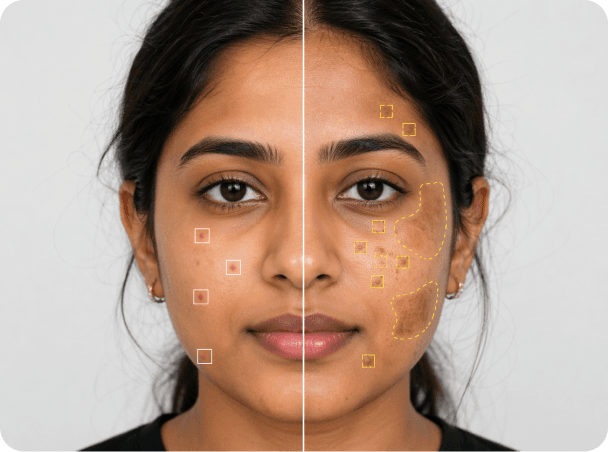
The Indian Skin AI Accuracy Gap
Why Western-trained models fail on Indian (Fitzpatrick 3–6) skin — and what the data actually shows.

The dataset powering skin AI is fundamentally biased.
A systematic review of the training data behind dermatology AI reveals a geographic and ethnic concentration that makes global claims of accuracy misleading.
“Of 70 image datasets, 79% of images originated from Europe, North America, and Oceania. Only 1.3% of datasets contained ethnicity metadata.”
— Wen et al., Lancet Digital Health (2022)
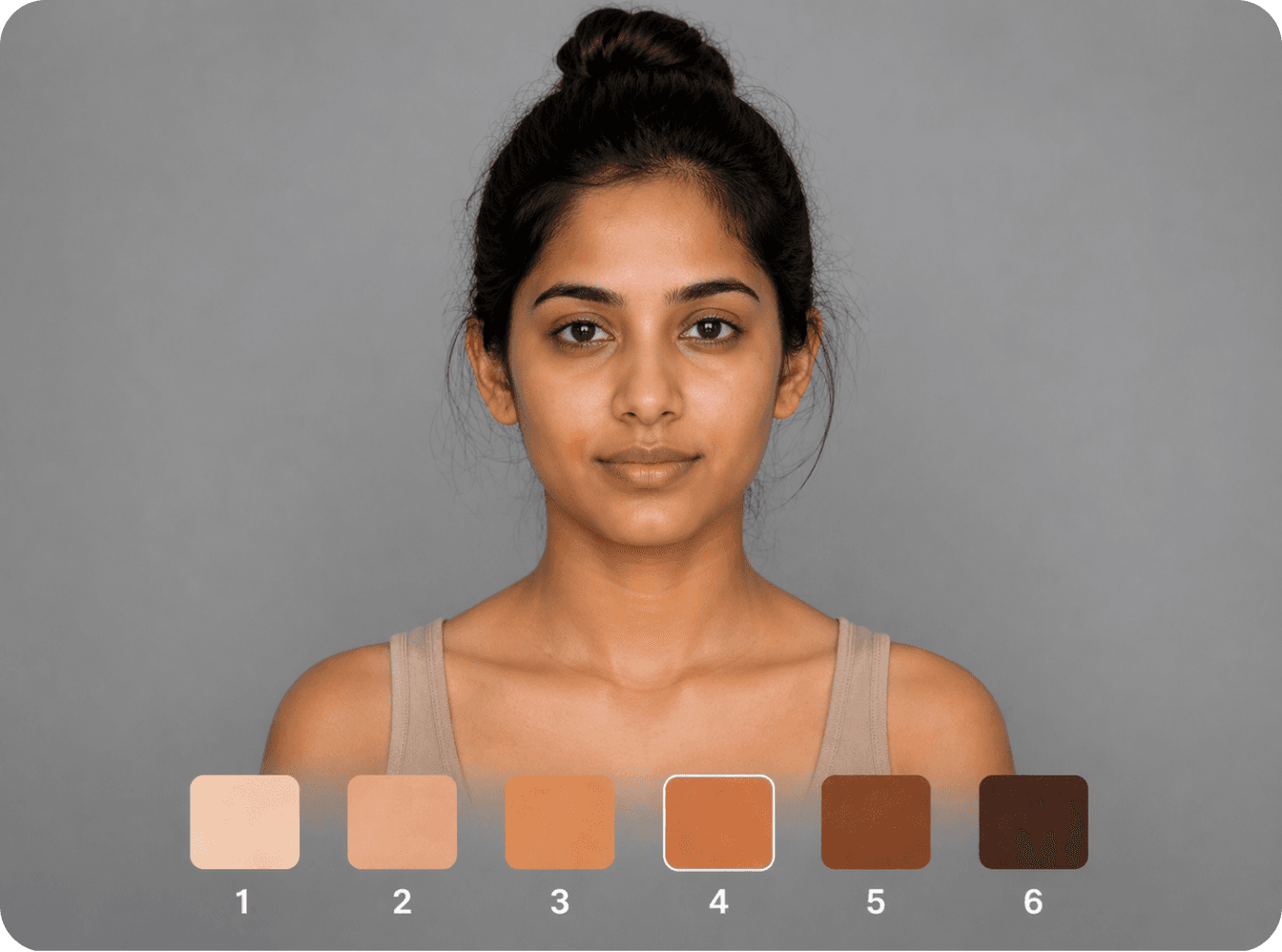
Where Bharatiya skin sits on the Fitzpatrick scale
Bharatiya skin predominantly falls in Fitzpatrick types III–VI. Most AI skin analysis models are validated primarily on types I–III — meaning they were never built for the majority of Bharatiya consumers.
Types I–II represent very light to light skin that burns easily — these types dominate Western training datasets.
Types III–VI, where most Bhartiya skin falls, have higher melanin density. This changes how conditions like pigmentation, acne scarring, and dark circles present — meaning AI models trained on lighter skin systematically misclassify these concerns.
Rupam.ai is the only AI skin analysis engine trained exclusively on Fitzpatrick 3–6 data from Bharatiya subjects, with expert-labelled ground truth.
The accuracy gap, concern by concern.
Internal validation on a balanced Fitzpatrick 3–6 test set. External audit in progress.

Acne
avg

Pigmentation
avg

Dark Circles
avg

Wrinkles
avg
| CONCERN | GLOBAL AVG. | RUPAM AI | STATUS |
|---|---|---|---|
| Dark Circles | 52.1% | 74.6% | PASS |
| Hyperpigmentation | 58.7% | 63.5% | PASS |
| Moles | N/A | 90.2% | PASS |
| Acne & Blemishes | 65.2% | 83.2% | PASS |
| Skin Type | N/A | 51.9% | UNDER TRAINING |
| Skin Age | N/A | MAE 4.99y | PASS |
| Oiliness | N/A | 57.5% | PASS |
| Wrinkles | N/A | 83.5% | PASS |
| Pores | N/A | 27.1% | UNDER TRAINING |
| Eye Bags | N/A | 51.0% | PASS |
| Blackheads | N/A | 57.0% | PASS |
These are our own internal validation results, measured against real labelled datasets — not third-party or FDA-certified benchmarks.
Accuracy questions
We tested Rupam.ai and four leading global skin analysis models on a balanced dataset of 5,000+ expert-labelled images across Fitzpatrick skin types III–VI. Each image was graded by at least two trained skin-image labellers using a documented scoring rubric.
We tested against four widely-used commercial skin analysis APIs. Due to licensing restrictions, we report aggregate results rather than naming individual vendors.
88%+ refers to the overall agreement between Rupam.ai's assessments and our expert-labelled ground truth across the skin parameters on Fitzpatrick 3–6 skin tones.
An independent third-party audit is currently in progress. We expect results by Q3 2026. Until then, all figures are from internal validation.
Training data bias. 79% of dermatology datasets originate from Europe, North America, and Oceania. Conditions like hyperpigmentation, melasma, and post-inflammatory changes present differently on darker skin tones and are systematically underrepresented.
We offer a research partnership programme that provides access to our benchmark methodology and anonymised test sets. Contact hello@rupam.ai for details.
See Rupam.ai accuracy on your own product catalogue
Get access to a high-quality Bhartiya skin dataset built for real-world accuracy and diversity. Simply request access to start building smarter, more personalized AI experiences for your users.